One Fridge, One Store, Hundreds of Sites: How to Prove Refrigeration Energy Savings Before a Nationwide Rollout
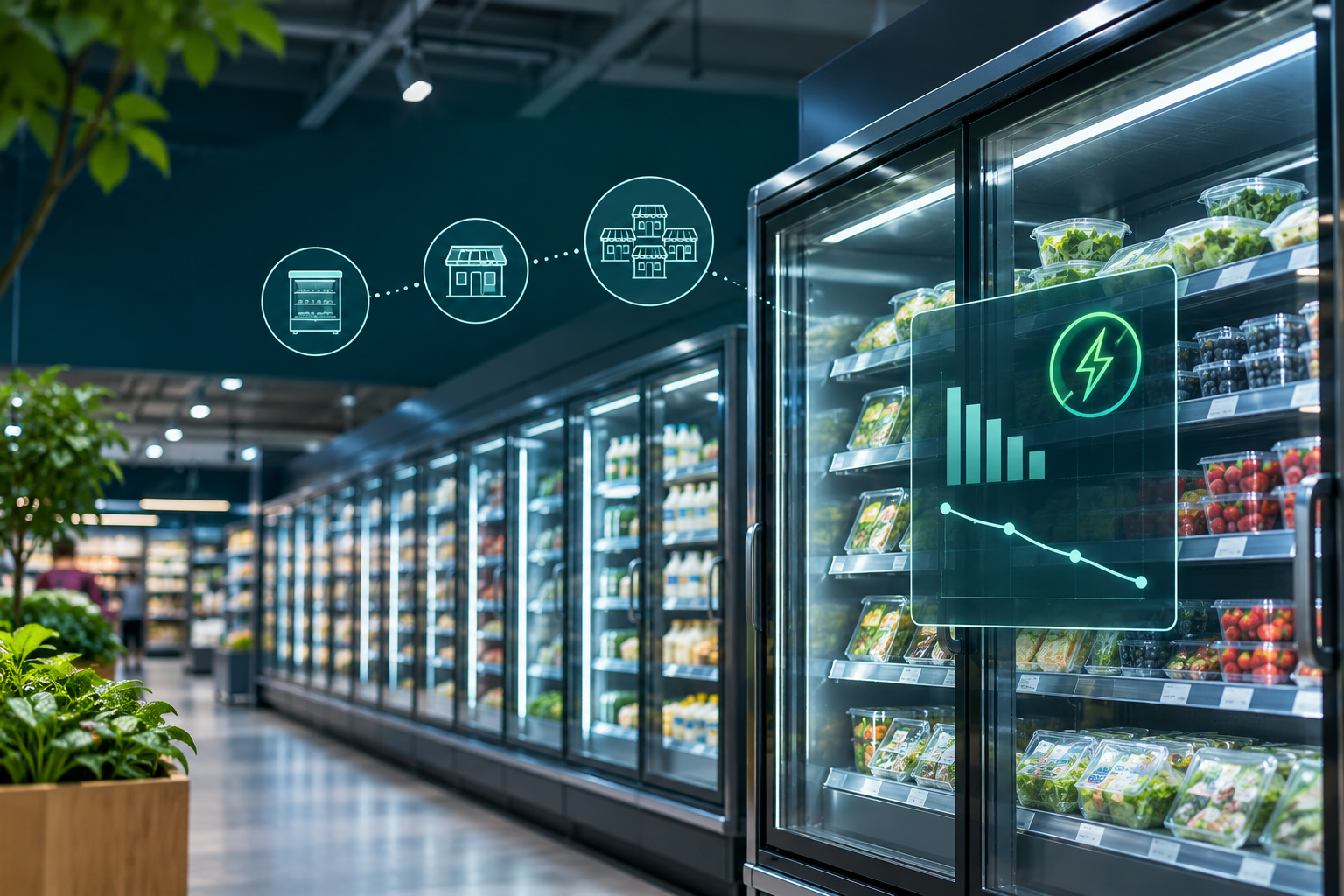
For supermarkets, retail chains and hospitality groups, refrigeration is more than an operational necessity. It is an ongoing energy demand that can quietly influence operating costs across hundreds of locations.
A single refrigeration unit may not seem particularly significant when reviewing an organisation's overall energy expenditure.
But multiply that equipment across an entire estate, and the financial opportunity becomes much more interesting.
The challenge is knowing whether an energy-saving intervention genuinely delivers results — and whether those results can be repeated.
That is why the most effective approach often begins with one unit, progresses to one store and only then considers a wider rollout.
Why refrigeration deserves closer attention
Unlike equipment that operates only during trading hours, refrigeration must maintain safe product temperatures throughout the day and night.
Its energy consumption is influenced by several factors:
- Compressor efficiency and running patterns
- Condenser cleanliness and airflow
- Door seals and frequency of opening
- Defrost cycles and temperature controls
- Ambient conditions and surrounding equipment
- Maintenance standards and operating practices
Even relatively small inefficiencies can become significant when repeated across an estate.
Importantly, increased energy consumption does not necessarily mean equipment needs replacing.
Sometimes the first opportunity is improving how existing equipment operates.
The problem with rolling out energy technology too quickly
An energy-saving technology may look attractive on paper.
The supplier presents a projected percentage reduction, the installation appears straightforward and the financial case looks promising.
However, a saving achieved under controlled conditions does not automatically translate into identical performance across every location.
Different stores have different refrigeration systems, equipment ages, layouts, opening hours and operating conditions.
A solution that performs well on one unit might produce different results elsewhere.
This does not make the technology ineffective. It means suitability needs to be established rather than assumed.
For organisations managing substantial property portfolios, that distinction is essential.
Stage one: Start with one refrigeration unit
Before committing to a wider installation, select a suitable unit for a controlled assessment.
The objective is to understand how the equipment operates before and after an intervention.
Where practical, the assessment should establish:
- Baseline electricity consumption over a representative period.
- Compressor operation and cycling patterns.
- Product temperatures and cooling performance.
- Ambient conditions and relevant operating variables.
- Maintenance condition and any existing faults.
Once the proposed optimisation measure is introduced, performance can be monitored against the baseline.
The assessment should account for changes in conditions that could otherwise distort the results.
After all, a reduction in electricity use is only valuable if the equipment continues to perform its intended function safely and reliably.
Stage two: Prove the results across one store
A successful single-unit assessment is encouraging, but it should not be treated as proof that an entire estate will achieve the same result.
The next stage is understanding how the technology performs across a broader selection of equipment.
A store-level trial provides an opportunity to examine different refrigeration loads, equipment types and operating conditions.
It can also reveal practical considerations that may not be apparent during an individual-unit assessment.
For example:
- Can installation be completed without disrupting trading?
- Are additional maintenance or enabling works required?
- Does performance vary between equipment types?
- Can site teams support ongoing operation?
- What are the actual installation and monitoring costs?
These findings are just as important as the measured energy reduction.
They help establish whether an intervention is commercially viable and operationally suitable for wider deployment.
Stage three: Build the case for a multi-site rollout
Once sufficient evidence has been collected, the next question becomes commercial.
What could the intervention deliver across the wider estate?
At this stage, the calculation needs to go beyond multiplying a percentage saving by the number of refrigeration units.
A credible business case should consider the number of suitable units, their actual energy consumption, installation costs, maintenance requirements and the expected life of the intervention.
It should also account for differences between sites.
Some locations may offer stronger returns than others. Some equipment may be unsuitable. Others may require operational improvements before any new technology is considered.
The result should be a prioritised rollout plan rather than a blanket recommendation.
Why independent measurement matters
The International Performance Measurement and Verification Protocol (IPMVP) provides a recognised framework for evaluating energy performance.
A central principle is that savings should be calculated by comparing energy consumption before and after an intervention, with appropriate adjustments for changes in operating conditions.
For refrigeration projects, this helps distinguish genuine performance improvements from changes caused by factors such as trading patterns, weather or equipment usage.
It also gives finance directors and facilities teams a clearer understanding of the evidence behind an investment decision.
The objective is not simply to demonstrate that a technology can save energy. It is to establish where, how and under what conditions it makes commercial sense.
What does this mean for supermarket and hospitality operators?
Organisations with large refrigeration estates have an advantage: they can identify repeatable opportunities across numerous locations.
But they also face a risk.
An unverified assumption, repeated hundreds of times, can become an expensive mistake.
By starting small, measuring performance and expanding only where justified, businesses can reduce that risk while identifying opportunities to improve energy efficiency.
A carefully planned trial can provide more than a savings figure.
It can create the foundation for an investment programme supported by measurable evidence.
How Green Wing Energy Solutions can help
Green Wing Energy Solutions works with commercial organisations to identify avoidable energy consumption, assess potential improvements and develop practical optimisation strategies.
Our approach begins with understanding how equipment and buildings operate.
Through our Onsite Discovery Assessment and Discovery Assessment Report and Roadmap, we help organisations distinguish operational improvements from technology opportunities, assess commercial suitability and establish how results should be measured.
For businesses operating refrigeration across multiple sites, this means moving beyond projected savings towards informed decisions backed by site-specific evidence.
Before considering a wider rollout, establish what works, where it works and how the results can be verified.
To discuss refrigeration energy optimisation or wider energy-efficiency opportunities across your estate, contact Green Wing Energy Solutions.
www.greenwingenergysolutions.com
Arrange an Energy Review Start with a free 15-minute discovery call.
Next step
See what your estate is really doing with energy.
Arrange an Energy ReviewStart with a free 15-minute discovery call.