What Is Your Building Costing You While Everyone Is Asleep?
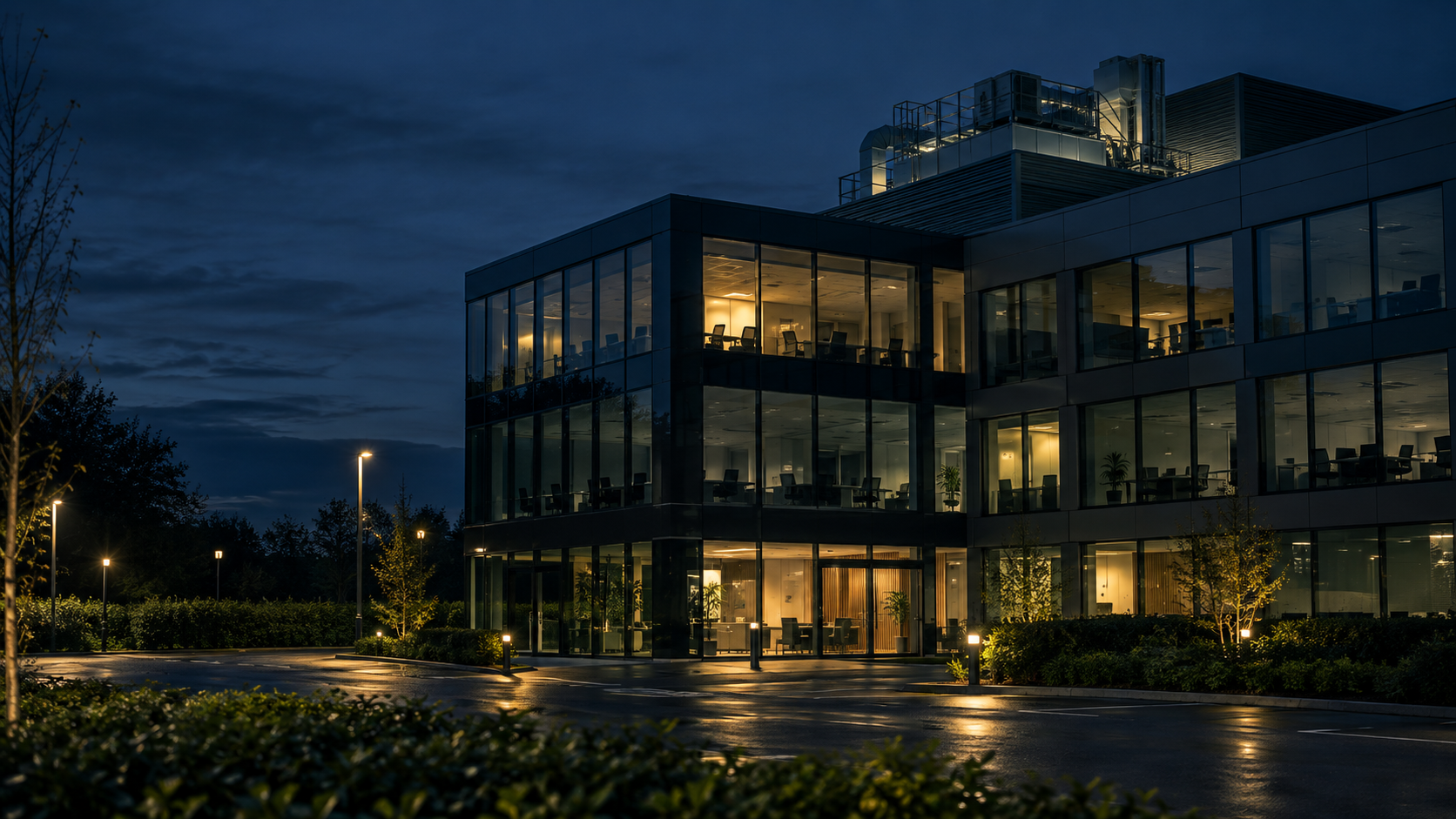
At the end of the working day, the lights go off, employees leave and the doors are locked.
But does your building actually stop using energy?
For many commercial sites, the answer is no. Heating, cooling, ventilation, lighting, pumps, refrigeration, hot-water systems, office equipment and other electrical loads can continue operating long after the building has emptied.
Some of that consumption will be essential. Refrigeration, servers, security equipment and safety-critical systems cannot simply be switched off.
However, the difference between the energy a building needs overnight and the energy it actually uses can reveal one of the clearest opportunities for reducing costs.
What is an overnight energy baseload?
Your building’s baseload is the level of energy it continues to use when normal activity has reduced or stopped.
For an office, this may be measured overnight or at weekends. For a hotel, care facility, leisure centre or manufacturing site operating for longer hours, the most useful comparison may be between busy and quieter periods.
A baseload is not automatically waste. Every building has different operational requirements. The important question is whether the level of consumption can be explained.
If a building is almost empty but its electricity demand remains close to its daytime level, something deserves further investigation.
Why overnight energy use is easily missed
Most organisations review energy through monthly bills. These show how much energy has been used overall, but not necessarily when it was consumed.
A total monthly figure can therefore hide:
Heating or cooling operating outside occupied hours.
Ventilation systems running continuously.
Lighting left on in empty areas.
Pumps operating when there is little or no demand.
Hot-water systems maintaining unnecessary temperatures overnight.
Computers, printers, vending machines and kitchen equipment left powered.
Refrigeration or cooling plant working harder than expected.
Timers and building-management schedules that no longer reflect actual operating hours.
These loads may not appear significant when viewed individually. However, if unnecessary equipment operates for 10 or 12 hours every night, the annual consumption can become substantial.
A simple example
Imagine that a site maintains an unexplained overnight electrical load of 20 kW for 12 hours each night.
20 kW × 12 hours × 365 days = 87,600 kWh per year.
At an illustrative electricity cost of 25p per kWh, that would represent approximately £21,900 per year.
This does not mean the entire amount could be eliminated. Some of the load may be necessary, and the actual commercial rate will vary between businesses.
It does show why baseload should not be dismissed as a small overnight issue. A modest continuous demand can become a significant annual cost.
How to carry out a basic overnight energy check
You do not necessarily need to install new technology before beginning your investigation.
1. Obtain your consumption data
Ask your electricity supplier or metering provider whether half-hourly consumption data is available. Many businesses can already access this information through their supplier portal, an advanced meter or a monitoring platform.
If you cannot access interval data, record meter readings at the end of the working day and again before the building becomes occupied. This will not provide the same level of detail, but it can offer an initial indication.
2. Choose a representative quiet period
Select a night, weekend or shutdown period when you understand how the site should be operating.
A bank holiday can be particularly revealing, although seasonal heating, refrigeration and essential processes must still be considered.
3. Identify the lowest consistent demand
Look at the consumption profile during the quietest hours.
Does demand fall sharply when activity stops, or remain unexpectedly high? Does it increase at a certain time? Are there repeated peaks throughout the night?
The shape of the profile can help distinguish a constant background load from equipment cycling on and off.
4. List what genuinely needs to remain on
Create a practical inventory of essential overnight loads, such as:
Refrigeration and temperature-controlled storage.
Servers and communications equipment.
Security, fire and safety systems.
Essential process equipment.
Occupied accommodation or 24-hour operational areas.
Estimate what these systems should reasonably consume and compare this with the measured baseload.
5. Walk the building when it is quiet
An out-of-hours site walk can reveal issues that remain invisible during a normal working day.
Listen for fans and pumps. Check plant-room controls. Look for illuminated empty rooms, operating screens, unnecessary heating and equipment that has been left running.
It is often easier to identify waste when the building is quiet and competing operational activity has stopped.
Common causes of a high baseload
Heating and cooling schedules
Time schedules are frequently copied forward, overridden or forgotten. Seasonal clock changes, power interruptions and changes in occupancy can all leave systems operating at the wrong times.
Heating and cooling may also operate against each other if their controls are not coordinated.
Ventilation and extraction
Fans can represent a significant continuous load, particularly when they operate at full speed regardless of occupancy or demand.
Check whether ventilation schedules reflect actual use and whether variable-speed controls, sensors or maintenance issues are affecting performance.
Hot-water circulation
Hot-water generation and circulation can continue through the night even where demand is minimal.
Any adjustment must protect hygiene and operational requirements, but the schedule, temperature and circulation strategy should still be reviewed.
Refrigeration and cooling
Refrigeration is an essential overnight load for many businesses, but unusually high consumption can indicate dirty condensers, damaged seals, poor temperature settings, simultaneous heating and cooling, refrigerant issues or equipment approaching failure.
The goal is not to switch essential cooling off. It is to confirm that it is operating efficiently.
Office and back-of-house equipment
Computers, monitors, printers, vending machines, kitchen equipment, display screens and chargers can remain powered throughout the night.
One device may make little difference. Hundreds of devices operating every night across several sites can create a meaningful load.
Do not simply switch everything off
Baseload reduction must be controlled and site-specific.
Equipment should not be isolated without understanding its purpose, safety requirements, manufacturer guidance and effect on connected systems. Abruptly changing heating, cooling, refrigeration or water-system operation can create operational, hygiene or maintenance risks.
The correct process is to:
Measure the existing load.
Identify what is creating it.
Separate necessary consumption from avoidable consumption.
Make controlled changes.
Measure again to confirm the result.
One site can provide lessons for an entire estate
For organisations operating multiple buildings, overnight consumption can also be used to compare similar sites.
If two buildings have comparable operating hours and functions but one maintains a much higher baseload, the difference provides a useful starting point for investigation.
The reason may be legitimate. One site may have additional refrigeration, longer occupancy or different operational requirements.
Alternatively, the comparison may expose inconsistent controls, maintenance problems or equipment that has been left operating unnecessarily.
Estate-wide comparison helps businesses focus attention on the sites where investigation is most likely to produce value.
Your empty building still has a story to tell
Energy waste is not always caused by one dramatic fault. It is often the result of equipment operating slightly longer than necessary, across many nights and many different systems.
Your overnight energy profile can reveal:
Whether shutdown routines are working.
Whether control schedules reflect current occupancy.
Whether equipment is cycling unexpectedly.
Whether one site behaves differently from the rest of the estate.
Whether an operational adjustment has delivered a genuine saving.
Before investing in new technology, find out what your building is already doing when nobody is watching.
The most useful question may not be “How much energy did we use this month?”
It may be: “Why were we still using this much at 2am?”
How Green Wing can help
Green Wing Energy Solutions helps organisations understand how energy is being used across their buildings and identify where avoidable consumption may be occurring.
Our evidence-led approach combines consumption analysis with practical site investigation, helping businesses separate genuine operational requirements from unnecessary energy use.
If you would like to understand what your buildings are consuming overnight—and why—contact Green Wing Energy Solutions to arrange an energy review.
Arrange an Energy Review Start with a free 15-minute discovery call.
Next step
See what your estate is really doing with energy.
Arrange an Energy ReviewStart with a free 15-minute discovery call.